Forming and Sintering Essentials of Low-Temperature Easy-Sintering Alumina Granulation Powder
Introduction
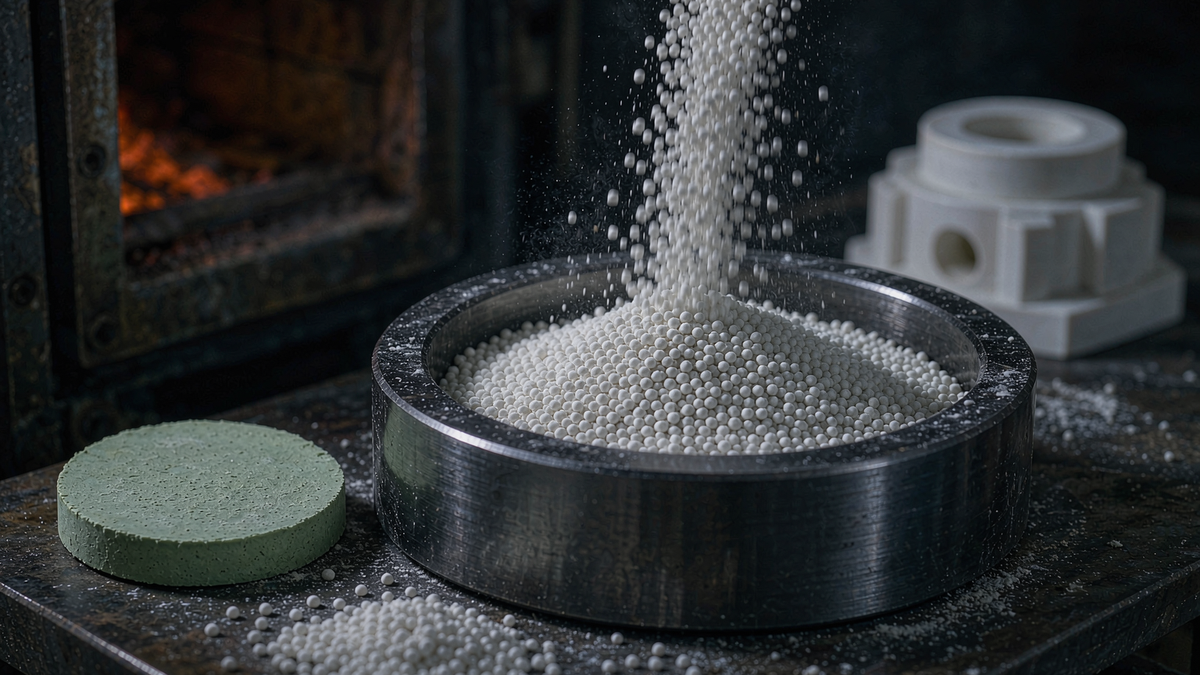
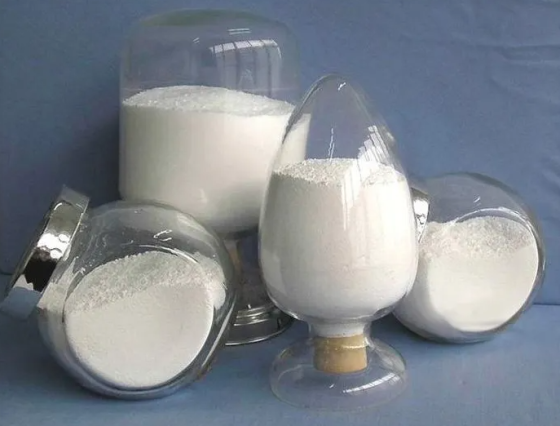
Granulation powder is the primary feedstock form for dry pressing and isostatic pressing. The granulation process solves the poor flowability and low die-filling density of ultrafine powders, and at the same time moves process-control responsibility forward from the forming step to the powder design stage. This article reviews the key control points of low-temperature easy-sintering alumina granulation powder in forming and sintering.
1. The core problem granulation powder must solve
Submicron and nano alumina powders are highly active but flow poorly and generate dust, making it difficult to achieve uniform green density by direct die filling. Spray granulation combines fine powder with a binder system into spherical agglomerates, significantly improving flowability and uniform die filling, providing the basis for dry pressing and isostatic pressing. Evaluation of granulation powder usually revolves around bulk density, Hall flow rate, particle strength, moisture content and binder content. Among these, particle strength determines whether granules can withstand pressing pressure without breaking, and is the key parameter for stable forming.
2. Phase composition design determines shrinkage behavior
The crystal structure of precision alumina ceramics should be the alpha phase. Completing the phase transformation at lower temperature in a high-temperature furnace suppresses primary grain growth and raises powder sintering activity. The transformation process requires control of temperature and time, with X-ray diffraction used to verify the crystal phase and confirm that the transformation rate meets downstream requirements. If transition phases remain before granulation, the product still undergoes transformation shrinkage during sintering, causing dimensional deviation or even cracking. Seeding is a mature route to lower the transformation temperature: adding about 1.5% alpha seeds to boehmite gel can lower the transformation temperature to 1075 degrees Celsius. Research shows seeds can lower it by up to 170 degrees Celsius, and what matters is the number concentration of seeds rather than their weight fraction.
3. Sintering aids and low-temperature sintering technology
Introducing appropriate additives into the pure alumina system is a common means of lowering sintering temperature and controlling microstructure. MgO is the most extensively studied additive in alumina sintering; its mechanism is complex, but it is generally believed to suppress abnormal grain growth. Liquid-phase-forming additive systems can lower the sintering temperature to the 1500 to 1600 degrees Celsius range. How the additive is introduced is equally important: wet-chemical methods can coat additive uniformly on particle surfaces, avoiding local segregation that causes inhomogeneous microstructure. For semiconductor and medical applications with extremely high purity requirements, the type and residue level of additives must be evaluated together with end-use cleanliness requirements.
4. Two-stage design of the heating curve
Alumina nanopowders show multistage shrinkage behavior during heating. The first stage corresponds to the polymorphic transformation window, where a slower heating rate, for example 2 to 5 degrees Celsius per minute, should be used to suppress grain growth during transformation. The second stage enters the matrix densification range, dominated by grain-boundary and lattice diffusion, requiring sufficient thermal energy for pore elimination and density increase. Green density is the precondition for designing the heating curve. When green density exceeds 57% of theoretical density, the average pore size is smaller, the coordination number of grains around pores decreases, favoring atom diffusion toward pores, and pure alpha alumina can reach a relative density above 99.6% at 1300 degrees Celsius without sintering aids.
5. Common defects and troubleshooting directions
Cracking and deformation are mostly related to uneven green density, uncontrolled transformation shrinkage or overheated ramp rates; troubleshooting should start with density uniformity in forming, then check phase composition and the heating curve. Porosity and low density usually point to hard agglomerates, insufficient green density or inadequate sintering temperature and holding time. Large pores between agglomerates form bimodal pore-size distributions and require higher temperatures to eliminate, at the cost of grain growth. Abnormal grain growth is often associated with impurity introduction, additive segregation or over-sintering. Dimensional deviation mostly stems from batch variation in powder shrinkage; consistency must be solved at the powder end, and adjusting sintering parameters alone can rarely cure it.
6. Moving the process window upstream to the powder
As the control points above show, the yield stability of forming and sintering is largely determined by the batch consistency of the powder. Batch fluctuations in particle size distribution, alpha-phase content, specific surface area, moisture content and binder content translate directly into differences in pressing density and shrinkage, and ultimately into dimensional scatter and performance dispersion of the final product. When selecting a granulation powder supplier, downstream customers should therefore examine, beyond single-batch test data, the consistency and traceability of indicators across multiple batches.
Conclusion
The high-purity low-temperature sintering alumina granulation powder of Jingci (Chengdu) New Materials targets dry pressing and isostatic pressing applications. Based on a particle size range of 150 to 500 nanometers and low-temperature easy-sintering characteristics, the company continues to invest in batch-to-batch control of particle size distribution, phase composition and moisture content, helping downstream customers stabilize their forming and sintering process windows and reduce yield losses caused by raw material fluctuation.
Main references
1. Journal of East China University of Science and Technology: phase transformation of different alumina precursors
2. Kumagai and Messing on seeded transformation of boehmite sols (cited in NASA SBIR reports and Japanese MRS reviews)
3. Japanese MRS review: effect of additives on solid-state sintering of alumina
4. Kintek: multistage shrinkage behavior of alumina nanopowders and two-step heating design
5. Heeger Materials: guide to the relationship between alumina powder properties and final ceramic performance
6. Ceramics International, 2026: AlF3 and seed assisted low-temperature synthesis of platelet alpha-Al2O3