Beyond 4N Purity: The Microstructural Indicators That Determine High-Purity Alumina Ceramic Performance
Introduction
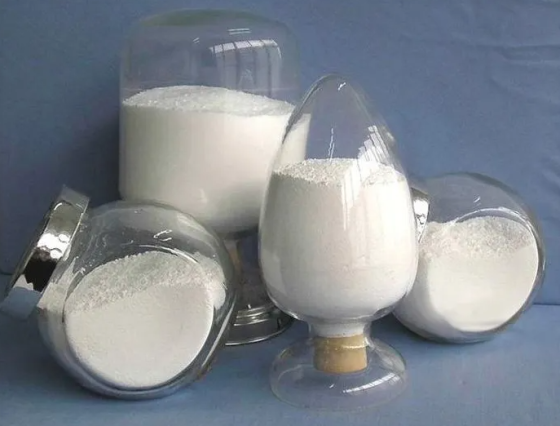
In the procurement and selection of high-purity alumina, purity is often treated as the primary indicator. Industry practice shows that 4N (99.99%) and 5N (99.999%) grades do determine whether a material can enter high-end applications such as transparent ceramics and sapphire. But once purity is met, what continues to widen the gaps in pricing and product yield are the powder's microstructural indicators. This article reviews six key indicators beyond purity and their mechanisms.
1. Purity defines the application threshold
The purity threshold of high-purity alumina is set by downstream processes. Transparent ceramics usually require the 99.99% class; raw materials for sapphire single-crystal growth require the 99.999% class; electronic substrates generally require above 99.5% with strict limits on Na2O content; medical implant applications tolerate very little Fe2O3 and SiO2. Each impurity acts differently: Na2O lowers volume resistivity and promotes low-melting phases; Fe2O3 affects color and biocompatibility; SiO2 tends to induce abnormal grain growth. Purity is the entry condition; beyond the threshold, differences in purity alone leave limited room for premium pricing.
2. Alpha-phase content and transformation route
The crystal structure of precision alumina ceramics should be the alpha phase. If transition phases such as gamma, delta or theta remain in the powder, volume changes during sintering cause cracking and deformation, so high-precision parts generally prefer powders with high alpha-phase content. In conventional processes, calcination to complete the alpha transformation takes place between 1200 and 1400 degrees Celsius; high-temperature, long-duration calcination improves transformation but coarsens primary grains and aggravates agglomeration. Seeding is the industry-recognized low-temperature transformation route: adding about 1.5% alpha-alumina seeds to boehmite gel can lower the transformation temperature to 1075 degrees Celsius. Research shows seeds can lower the transformation temperature by up to 170 degrees Celsius and yield fully dense, submicron-grained sintered bodies at 1200 degrees Celsius. Notably, what matters is the number concentration of seeds rather than their weight fraction; seeds also suppress wormlike structures, producing a uniform, agglomerate-free microstructure.
3. Particle size distribution and packing design
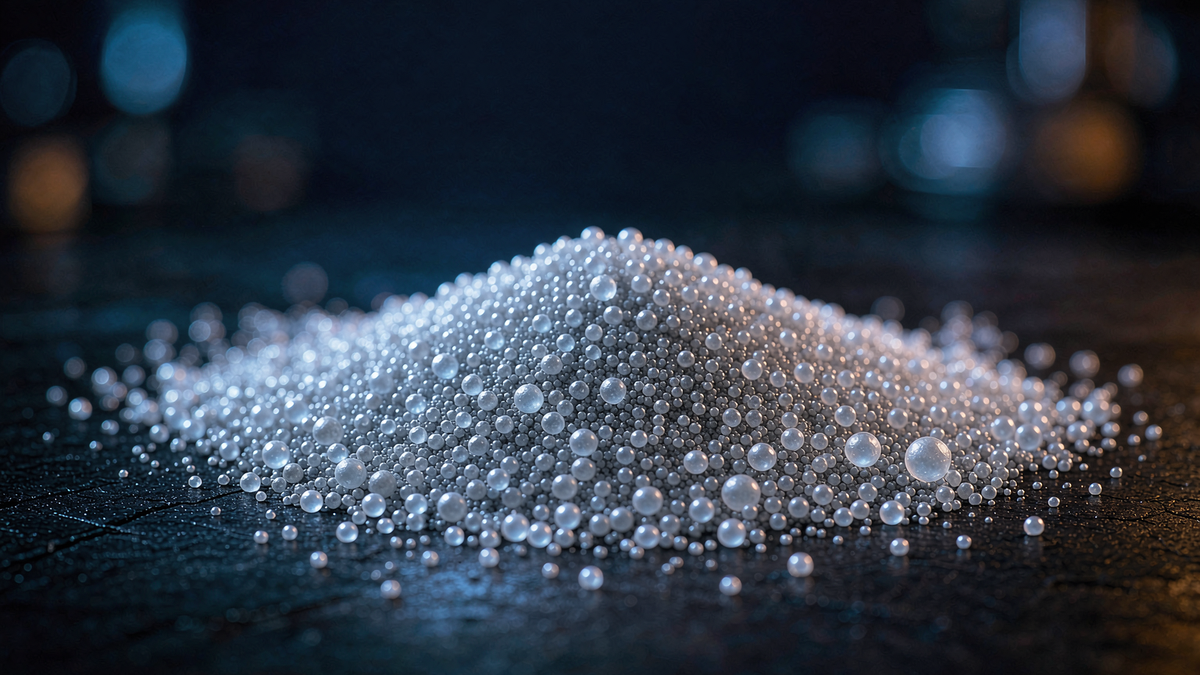
Particle size distribution directly determines sintering behavior. An overly wide distribution mixes large and small particles, leaving cavities in the packing and residual pores after sintering; an overly narrow distribution benefits grain uniformity but caps packing density, making particle grading an important design tool. A 2026 study built binary to quaternary graded systems from four monodispersed spherical alpha-alumina powders: the four-level graded system showed the fastest densification rate, the lowest porosity, and a sintering activation energy reduced to 129.95 kJ/mol. The authors conclude that multiscale grading not only optimizes the particle contact network and mass-transport paths but, crucially, lowers the energy barrier for atomic migration, providing a mechanistic basis for controlling sintering kinetics through powder structure design.
4. The logic of particle morphology selection
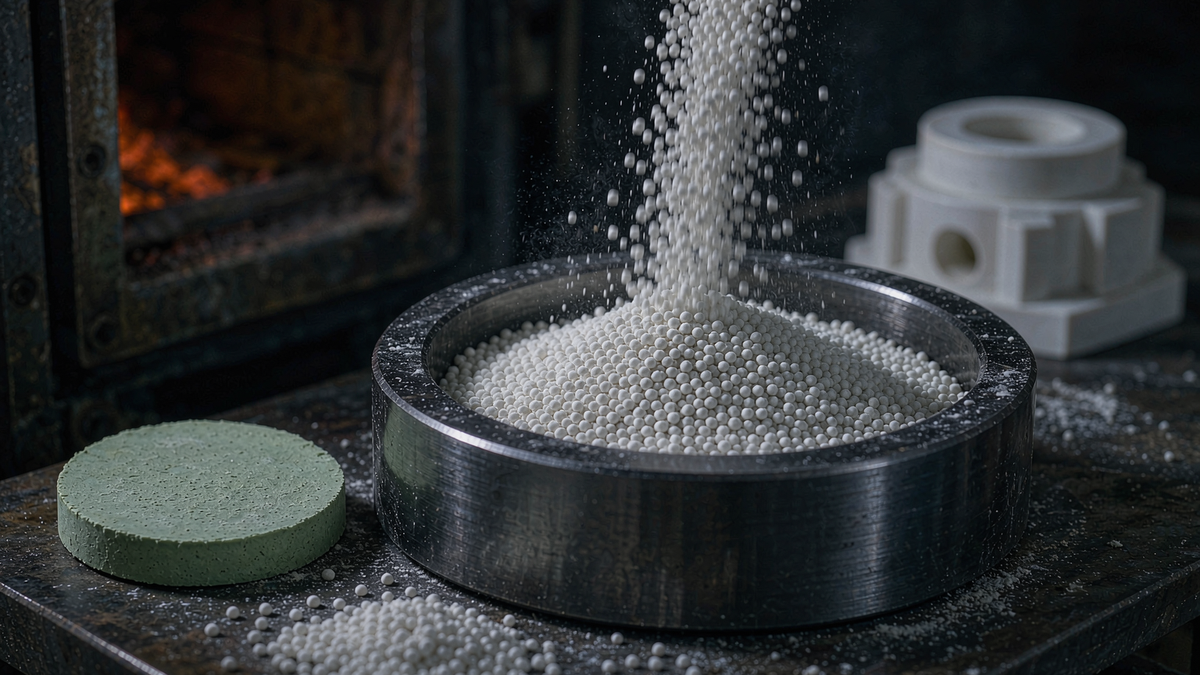
Morphology affects packing density, flowability and forming processes. Spherical and equiaxed particles pack uniformly and flow well, making them the preferred choice for dry pressing and isostatic pressing; platelet particles have unique value in ceramic toughening and thermal-conductivity networks, as their two-dimensional structure promotes layered arrangement during sintering, enhancing anisotropic mechanical properties and in-plane thermal conductivity. A 2026 study achieved complete transformation of platelet alpha-alumina at 800 degrees Celsius through precursor selection, AlF3 addition and seeding, 100 to 200 degrees Celsius lower than conventional methods. No morphology is absolutely superior; the key is matching the forming method and end-performance targets.
5. Dispersibility and hard agglomerates
Ultrafine powders have high specific surface area and high surface energy. Under-coordinated surface atoms generate strong van der Waals and electrostatic forces, and surface hydroxyl groups readily form hydrogen bonds, giving rise to agglomeration. Hard agglomerates cannot be fully eliminated during sintering and form pores and cracks that reduce density and mechanical performance. Agglomerated powders often develop bimodal pore-size distributions; large pores between agglomerates slow densification and require higher sintering temperatures to compensate. Stability of slurry systems depends on interface control: the isoelectric point of alpha alumina lies roughly between pH 8 and 9.3; away from this range, the absolute value of the Zeta potential rises and electrostatic repulsion between particles strengthens. Dispersants can shift the isoelectric point and widen the usable pH window. Note that simply increasing dispersant dosage does not improve stability: at unsuitable pH, polymer chains coil up, increasing organic residue and burdening the subsequent binder-removal step.
6. Balancing specific surface area and sintering activity
Specific surface area represents the sintering driving force of a powder. High specific surface area means high surface energy and strong sintering activity, enabling densification at lower temperatures; but excessive activity brings problems such as too-rapid shrinkage and difficult dimensional control. Engineering practice pursues a balance between activity and controllability of the sintering process rather than maximizing a single dimension, which also explains why some high-surface-area powders do not outperform medium-specification products on real production lines.
7. Batch consistency is the threshold of mass production
Sample test data can approach international levels, but batch-to-batch variation in volume production is the main obstacle to entering leading supply chains. Material certification by high-end customers typically takes one to three years, and switching suppliers after certification is costly. Customers therefore assess not single test results but whether particle size distribution, alpha-phase content, impurity profile, specific surface area and moisture content remain simultaneously stable across multiple batches. Batch consistency spans both purity and microstructure; it is the true competitive focus after purity targets are met.
Conclusion
Once purity passes 4N, competition in high-purity alumina shifts from chemical indicators to microstructure and batch stability. The high-purity alumina ceramic powders of Jingci (Chengdu) New Materials are based on 3N to 4N purity, cover particle sizes from 150 to 500 nanometers and feature low-temperature easy sintering. The company continues to invest in dispersibility, particle uniformity and batch stability, providing reproducible powder batches for downstream applications in semiconductors, electronic ceramics and aerospace.
Main references
1. Journal of Advanced Ceramics, 2026: multiscale grading of monodisperse spherical Al2O3 and sintering activation energy
2. Ceramics International, 2026: AlF3 and seed assisted low-temperature synthesis of platelet alpha-Al2O3
3. Journal of East China University of Science and Technology: phase transformation of different alumina precursors
4. Kumagai and Messing on seeded transformation of boehmite sols (cited in NASA SBIR reports and Japanese MRS reviews)
5. Heeger Materials: guide to the relationship between alumina powder properties and final ceramic performance
6. Kintek: multistage shrinkage behavior of alumina nanopowders and two-step heating design
7. Chemisonic: uniform suspension control of alumina nanopowders before sintering
8. IJCT, 2024: process condition optimization of gel-cast ceramic parts